![[personal profile]](https://www.dreamwidth.org/img/silk/identity/user.png) forisma
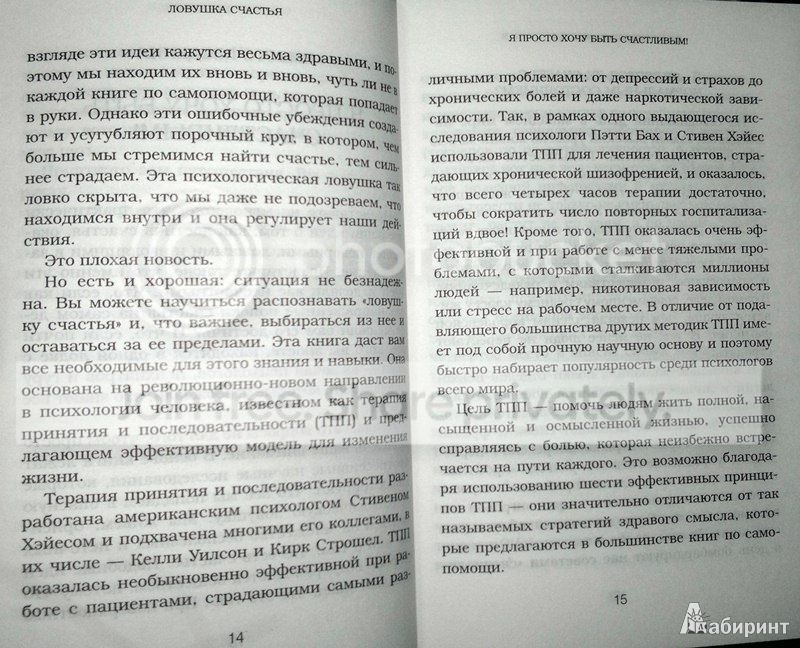
forismaО книге The Happiness Trap я узнала от poroshoknevhodi, и сразу же решила её прочитать.
Это одна из самых лучших и грамотных книг для тех, кто хочет разобраться в своих эмоциях, научиться обращаться с негативом, разорвать замкнутый круг недовольства собой и так далее и так далее.
Иллюстрации из интернета, на английском книга лежит в сети по ссылке выше, на русском книгу можно приобрести в интернет магазинах, я брала в библиотеке и читала на голландском.

Техники, используемые в книге, абсолютно действенны, но хотелось бы отметить, что лучше наряду с прочтением на регулярной основе практиковать параллельно медитацию. Это позволит:
а) понять, что медитация - это тренировка мозга мыслить в правильном направлении для развития ощущения внутреннего баланса, а не какая-то эзотерическая фишка;
б) понимать с лёта, что имеет ввиду автор книги и где-то даже мухлевать на предложенных им упражнениях, потому что правильная медитационная техника покроет их;
Но можно и без медитации, просто выполнять упражнения из книги.
Книга покрывает широкий спектр потребностей человека в изменениях в сторону meaningful life - жизни со смыслом, а не берёт, как многие современные горе-тренинги, какой-то кусочек жизни на изменение в попытках сделать человека счастливым, заставив его выполнить какой-то план.

Ещё хочу вставить сюда отрывок из книги, который дал мне такой глубокий инсайт, что я наконец-то приняла решение начать искать другую работу.
The True Meaning Of Acceptance
Acceptance does not mean ‘putting up with’ or resigning yourself to anything. Acceptance is about embracing life, not merely tolerating it. Acceptance literally means ‘taking what is offered’. It doesn’t mean giving up or admitting defeat; it doesn’t mean just gritting your teeth and bearing it. It means fully opening yourself to your present reality—acknowledging how it is, right here and now, and letting go of the struggle with life as it is in this moment.
But what if you want to improve your life and not just accept it as it is? Well, that’s the whole purpose of this book. But the most effective way to make changes in your life is to start by fully accepting it. Suppose you are walking across ice. In order to safely take the next step, you first need to find a firm foothold. If you try moving forward without doing that, then you’re likely to fall flat on your face.
Acceptance is like finding that firm foothold. It’s a realistic appraisal of where your feet are and what condition the ground is in. It doesn’t mean that you like being in that spot, or that you intend to stay there. Once you have a firm foothold, you can take the next step more effectively. The more fully you accept the reality of your situation—as it is, here and now—the more effectively you can take action to change it.
The Dalai Lama exemplifies this beautifully. He fully accepts that China has invaded Tibet and that he is forced to live in exile from his own country. He doesn’t waste time and energy in wishful thinking, getting outraged or dwelling morosely on what he’s lost. He knows that won’t help. Nor does he admit defeat or throw the whole issue into the ‘too-hard basket’. Instead he acknowledges that right now this is the way it is and at the same time he does everything in his power to help. He actively campaigns all around the world to increase public and political awareness of Tibet’s predicament and to raise financial support for its people.
In another example, let’s consider the case of domestic violence. If your partner is physically violent, the first step is to accept the reality of the situation: that you are in danger and you need to take action to protect yourself. The next step is to take action: get some professional help, take legal action and/or leave the relationship. In order to take this action, you will need to accept the anxiety, guilt and other painful thoughts and feelings that are likely to rise. So this is what ACT is all about: acceptance and action, side by side.
The core philosophy of ACT is neatly encapsulated in the Serenity Challenge:
Develop the courage to solve those problems that can be solved, the serenity to accept those problems that can’t be solved, and the wisdom to know the difference.
If your life isn’t working for you, the only sensible thing is to take action to change it. That action will be far more effective when you start from a place of acceptance. All the time and energy that you waste on struggling with thoughts and feelings could be far more usefully invested in taking action—the right action. A rich, full and meaningful life comes about through accepting your thoughts and feelings instead of fighting them, and taking effective action, guided by your deepest values.
So what are the costs of non-acceptance? What happens in the long run when you try to avoid or get rid of unpleasant thoughts and feelings? Do your control strategies work? Are they giving you the life you want? Acceptance is a powerful alternative to control. You’ve already discovered that many unpleasant thoughts are far less painful when defused, and in later chapters you’ll discover similar transformations with negative feelings.
Это одна из самых лучших и грамотных книг для тех, кто хочет разобраться в своих эмоциях, научиться обращаться с негативом, разорвать замкнутый круг недовольства собой и так далее и так далее.
Иллюстрации из интернета, на английском книга лежит в сети по ссылке выше, на русском книгу можно приобрести в интернет магазинах, я брала в библиотеке и читала на голландском.

Техники, используемые в книге, абсолютно действенны, но хотелось бы отметить, что лучше наряду с прочтением на регулярной основе практиковать параллельно медитацию. Это позволит:
а) понять, что медитация - это тренировка мозга мыслить в правильном направлении для развития ощущения внутреннего баланса, а не какая-то эзотерическая фишка;
б) понимать с лёта, что имеет ввиду автор книги и где-то даже мухлевать на предложенных им упражнениях, потому что правильная медитационная техника покроет их;
Но можно и без медитации, просто выполнять упражнения из книги.
Книга покрывает широкий спектр потребностей человека в изменениях в сторону meaningful life - жизни со смыслом, а не берёт, как многие современные горе-тренинги, какой-то кусочек жизни на изменение в попытках сделать человека счастливым, заставив его выполнить какой-то план.
Ещё хочу вставить сюда отрывок из книги, который дал мне такой глубокий инсайт, что я наконец-то приняла решение начать искать другую работу.
The True Meaning Of Acceptance
Acceptance does not mean ‘putting up with’ or resigning yourself to anything. Acceptance is about embracing life, not merely tolerating it. Acceptance literally means ‘taking what is offered’. It doesn’t mean giving up or admitting defeat; it doesn’t mean just gritting your teeth and bearing it. It means fully opening yourself to your present reality—acknowledging how it is, right here and now, and letting go of the struggle with life as it is in this moment.
But what if you want to improve your life and not just accept it as it is? Well, that’s the whole purpose of this book. But the most effective way to make changes in your life is to start by fully accepting it. Suppose you are walking across ice. In order to safely take the next step, you first need to find a firm foothold. If you try moving forward without doing that, then you’re likely to fall flat on your face.
Acceptance is like finding that firm foothold. It’s a realistic appraisal of where your feet are and what condition the ground is in. It doesn’t mean that you like being in that spot, or that you intend to stay there. Once you have a firm foothold, you can take the next step more effectively. The more fully you accept the reality of your situation—as it is, here and now—the more effectively you can take action to change it.
The Dalai Lama exemplifies this beautifully. He fully accepts that China has invaded Tibet and that he is forced to live in exile from his own country. He doesn’t waste time and energy in wishful thinking, getting outraged or dwelling morosely on what he’s lost. He knows that won’t help. Nor does he admit defeat or throw the whole issue into the ‘too-hard basket’. Instead he acknowledges that right now this is the way it is and at the same time he does everything in his power to help. He actively campaigns all around the world to increase public and political awareness of Tibet’s predicament and to raise financial support for its people.
In another example, let’s consider the case of domestic violence. If your partner is physically violent, the first step is to accept the reality of the situation: that you are in danger and you need to take action to protect yourself. The next step is to take action: get some professional help, take legal action and/or leave the relationship. In order to take this action, you will need to accept the anxiety, guilt and other painful thoughts and feelings that are likely to rise. So this is what ACT is all about: acceptance and action, side by side.
The core philosophy of ACT is neatly encapsulated in the Serenity Challenge:
Develop the courage to solve those problems that can be solved, the serenity to accept those problems that can’t be solved, and the wisdom to know the difference.
If your life isn’t working for you, the only sensible thing is to take action to change it. That action will be far more effective when you start from a place of acceptance. All the time and energy that you waste on struggling with thoughts and feelings could be far more usefully invested in taking action—the right action. A rich, full and meaningful life comes about through accepting your thoughts and feelings instead of fighting them, and taking effective action, guided by your deepest values.
So what are the costs of non-acceptance? What happens in the long run when you try to avoid or get rid of unpleasant thoughts and feelings? Do your control strategies work? Are they giving you the life you want? Acceptance is a powerful alternative to control. You’ve already discovered that many unpleasant thoughts are far less painful when defused, and in later chapters you’ll discover similar transformations with negative feelings.


![[identity profile]](https://www.dreamwidth.org/img/silk/identity/openid.png)
no subject
Date: 2014-03-15 11:06 am (UTC)no subject
Date: 2014-03-15 11:11 am (UTC)no subject
Date: 2014-03-15 11:57 am (UTC)а я не люблю на голландском читать..хотя умею..
надо будет в интернете порыться..
no subject
Date: 2014-03-15 12:02 pm (UTC)